Montréal
Monday, November 2, 2026
1,016accounts
352plexes, multi-units and commercial
Online pre-registration recommended before Saturday, October 17. City list of October 8, updated until the sale.
On November 2, Montréal auctions 1,016 properties for unpaid taxes. TaxeRadar shows you which ones are plexes, where they are and what they look like, before the auction.
7085 rue Fabre, Rosemont. 1944 triplex, lot 3 792 247. Montréal sale of November 2, 2026.
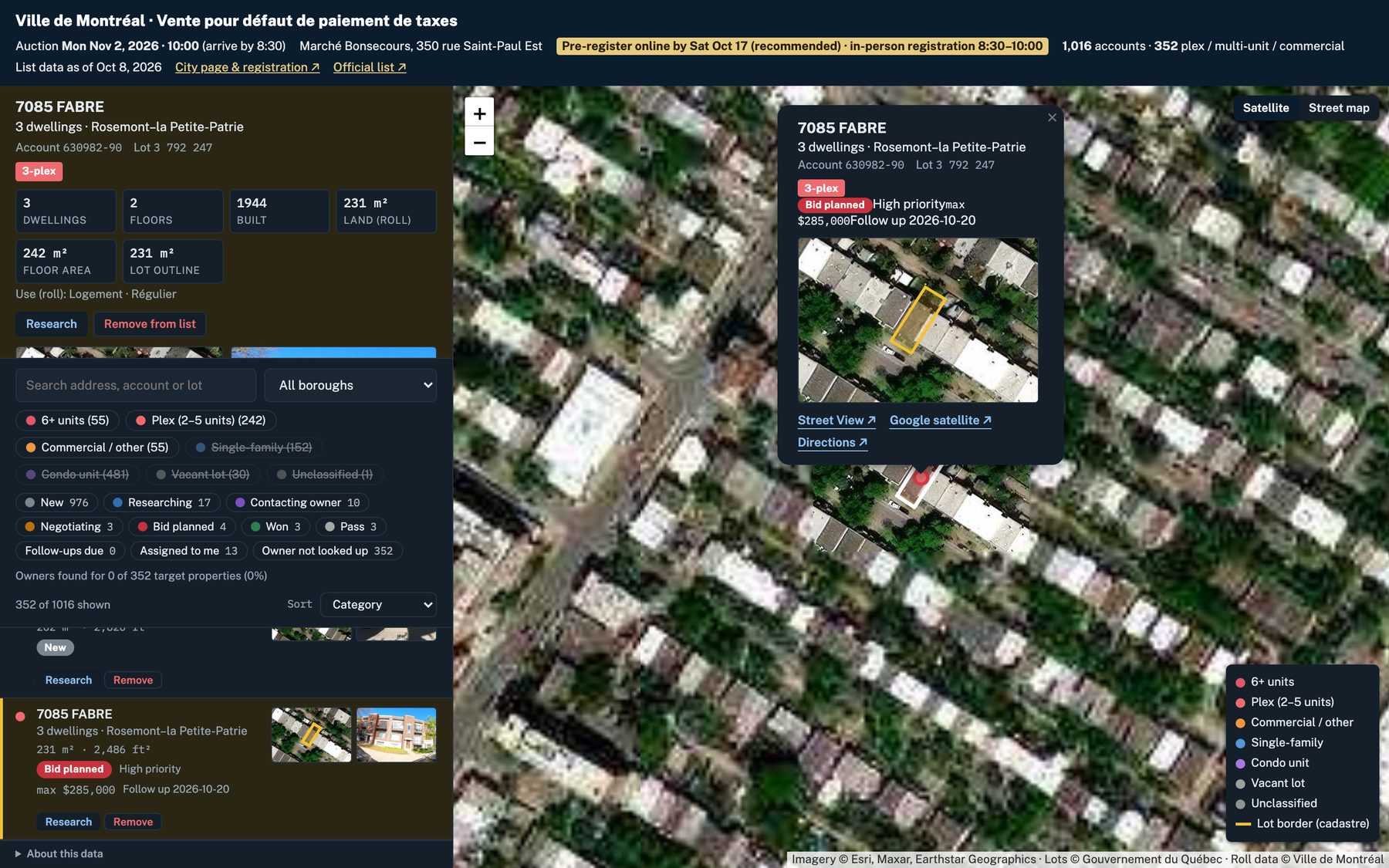
Online pre-registration recommended before Saturday, October 17. City list of October 8, updated until the sale.
First public notice. The second notice in November will be added when published.
Every public tax-sale notice in Québec is mapped within 24 hours of publication.
Each city publishes its tax-sale notice as a table: an account number, a lot number, an address. Hundreds of rows, with no map, no photo and no way to sort.
Finding the 352 plexes and commercial buildings among Montréal's 1,016 accounts, then checking each one, takes days. The sale itself lasts one morning.

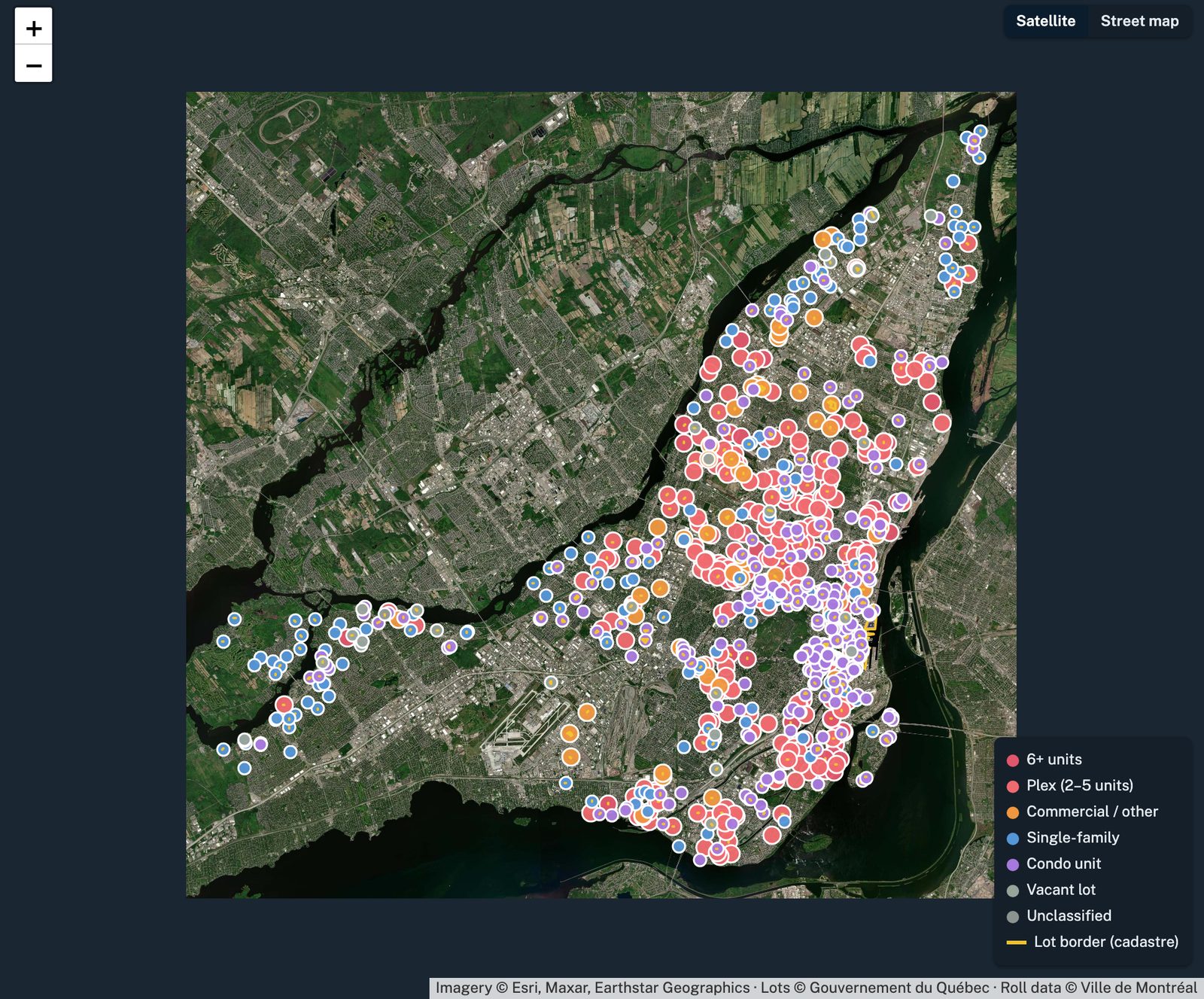
Every account on the list is placed on a satellite map with the exact lot border from the Québec cadastre. Plexes, buildings with six or more units and commercial properties show first; condos, single-family homes and vacant lots are one click away.
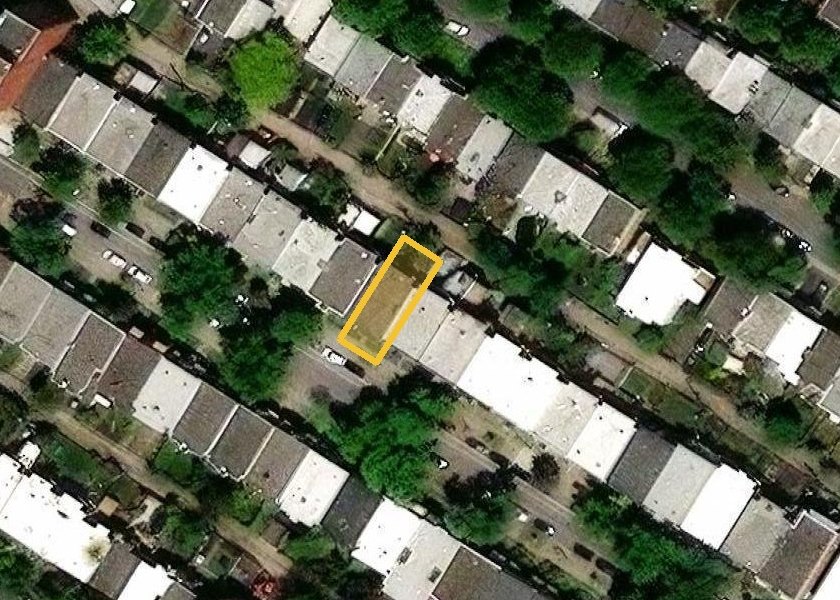
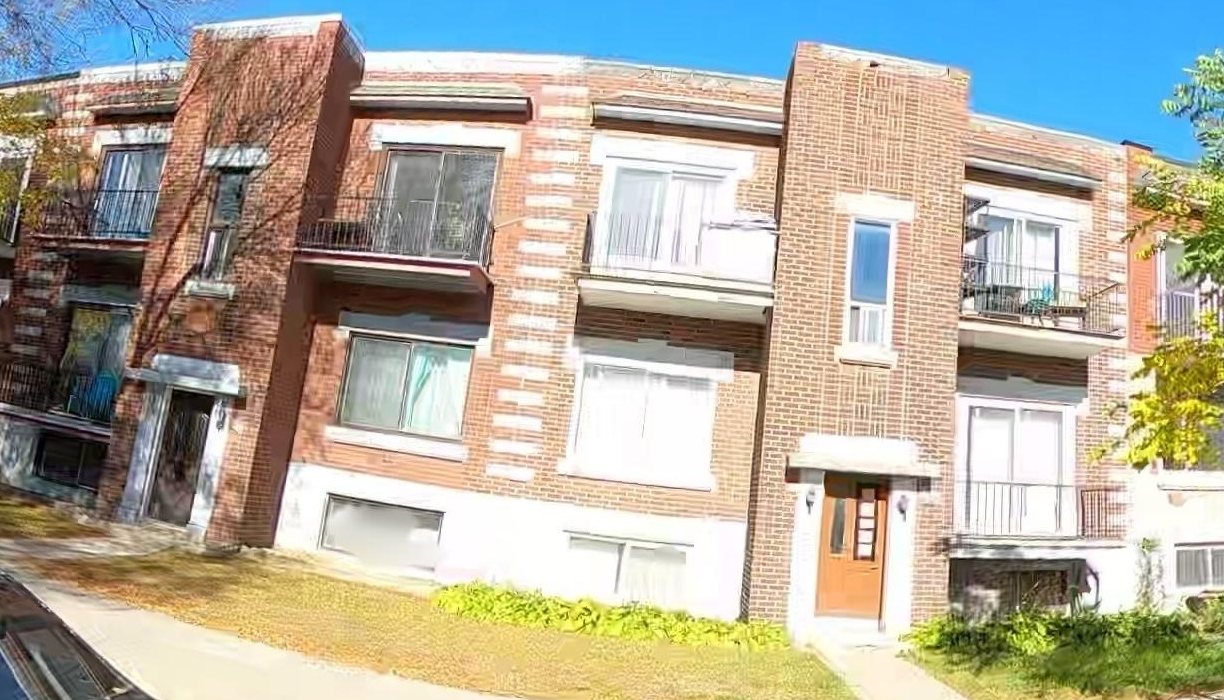
For each building: the satellite view with the lot border, the most recent street photo, and the assessment-roll data: dwellings, floors, year built, land and floor area, use.
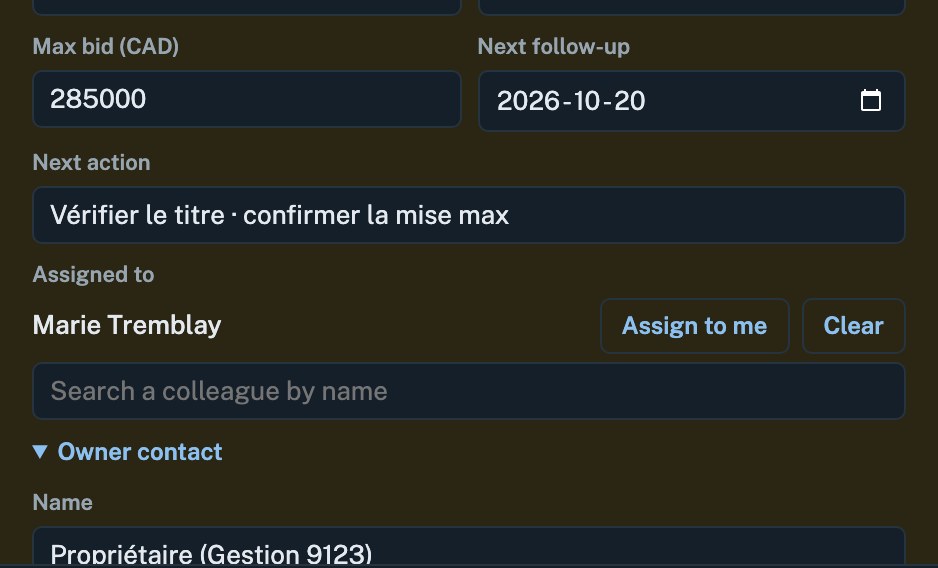
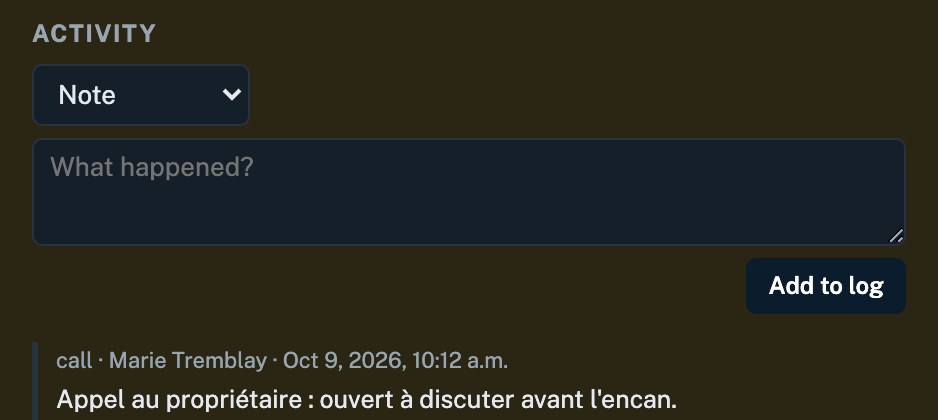
Track every property you are working on. Each one has a stage, a priority, a maximum bid and a follow-up date. Calls and visits go in its log. Your pipeline is private to your account.
The city publishes its tax-sale notice, usually two to three months before the auction.
Within 24 hours, every account is geolocated, classified, illustrated and enriched with roll data.
You get the link, remove what you do not want, set your bids and show up to the auction prepared.
A tax sale is not an ordinary sale. Here is what to understand before you bid. General information, to be confirmed with your notary.
When an owner has not paid municipal taxes, the city can have the property sold at public auction to recover what is owed. The property goes to the highest bidder, who receives a certificate of adjudication. The owner can pay up to the moment of the sale, in which case the property is withdrawn from the list.
After the sale, the former owner (or their creditors) has one year to buy the property back. They must repay the purchaser the price paid plus 10% interest per year, and any fraction of a year counts as a full year. If nobody exercises this right, the purchaser can request the final deed of sale.
Conditions vary by city. In Montréal, the adjudication price is payable immediately, using the payment methods set out in the conditions of sale published by the City. Read the conditions of the city concerned before attending; TaxeRadar summarizes them in each map.
The property is sold as is. Check the title at the Land Register, any mortgages and charges that may survive, the condition of the building and its occupancy. The TaxeRadar file gathers the links and data to start that check, but does not replace it.
Lists come from the cities' public notices. Lot borders come from the Québec cadastre, assessment data from municipal rolls, satellite imagery from Esri and Maxar, and street photos from Mapillary (CC BY-SA). Data is refreshed each time the city updates its list.
TaxeRadar opens with the Montréal sale of November 2. Create a free account to get the full Montréal map, updates until the sale and your own pipeline.
Free during the launch. Already have an account? Sign in. Questions: john@garabedian.ca
Watch the 15-second overview